Free printable
Fall Pies Recipe Cards
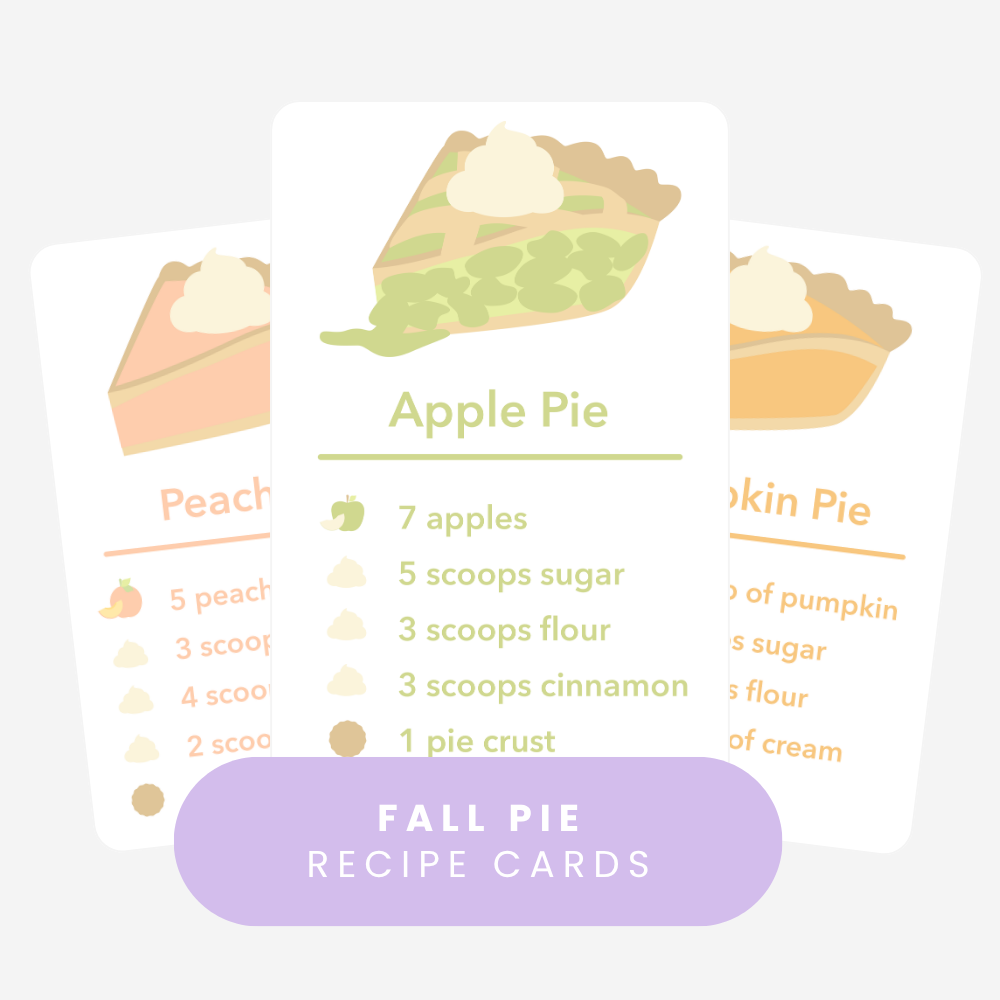
Start with the free Fall Pie Recipe Cards. Print the visual recipes, add a few scoops and pretend ingredients, and your tiny bakery is ready to open.
Get the printable
Turn pretend baking into hands-on learning with a pie sensory play setup built around scooping, counting, filling, and serving. Kids choose a pie recipe, gather their pretend ingredients, count each scoop, fill their crust, and serve their creation from a tiny bakery. The visual recipe gives sensory play a simple mission while still leaving plenty of room for imagination. Along the way, preschoolers practice counting, sequencing, following directions, fine-motor control, vocabulary, and pretend play.
Turn pretend baking into hands-on learning with a pie sensory play setup built around scooping, counting, filling, and serving. Kids choose a pie recipe, gather their pretend ingredients, count each scoop, fill their crust, and serve their creation from a tiny bakery. The visual recipe gives sensory play a simple mission while still leaving plenty of room for imagination. Along the way, preschoolers practice counting, sequencing, following directions, fine-motor control, vocabulary, and pretend play.
Start with the free Fall Pie Recipe Cards. Print the visual recipes, add a few scoops and pretend ingredients, and your tiny bakery is ready to open.
Get the printableEverything for this setup, in one list.
The original GoodnightFox setup uses colored chickpeas as pretend fruit filling alongside pie-making pieces.
Follow along at your own pace.
Let your child choose a visual recipe card. The pictures show which pretend ingredients they need and how many scoops to add, giving even pre-readers a simple recipe to follow.
Set out the pie crust, sensory fillers, scoops, and containers of pretend sugar, flour, cream, fruit, or other ingredients. Invite your child to find each ingredient shown on the card.
Follow the recipe one ingredient at a time. Count each scoop aloud as it goes into the pie. For younger preschoolers, count together. Older children can try matching the quantities independently.
Add the pretend filling to the crust and arrange the ingredients however your baker likes. There is no need for the finished pie to look exactly like the picture.
Add a pretend topping, place the finished pie in the bakery, and decide who gets the first slice. Then choose another recipe and start again.
Children count scoops and ingredients as they follow the recipe.
Recipe cards introduce the idea that activities happen in an order: choose, gather, scoop, fill, top, and serve.
Visual prompts give preschoolers simple multi-step instructions they can increasingly follow on their own.
Scooping, pouring, pinching, arranging, and transferring materials strengthen hand control.
Children become bakers, customers, servers, and shop owners.
Compare quantities, count ingredients, and explore more, less, same, full, and empty.
Which pie should we bake first?
What ingredient comes first?
How many scoops do we need?
Do we need more or less filling?
What comes next?
Who are you baking your pie for?
What flavor would you invent?
How much would your pie cost in your bakery?
Can you make two pies with different fillings?
Which pie used the most scoops?
Same setup, different challenge.
Add a menu, order tickets, play money, and bakery signs and turn the sensory setup into dramatic play.
Have a parent, sibling, or stuffed animal order a pie and let the child prepare it.
Ask children to design their own pie and decide how many scoops of each ingredient it needs.
Make two recipes and compare which used more or fewer ingredients.
Use the visual recipes with a mud kitchen and appropriate outdoor materials.
Use fall flavors such as pumpkin and apple or switch to winter-inspired pie recipes later in the year.